

The future is here.
Are we ready?
A nationally representative longitudinal survey tracking how Americans perceive, use, and worry about AI — its impact on journalism, democracy, disinformation, and the future of work.
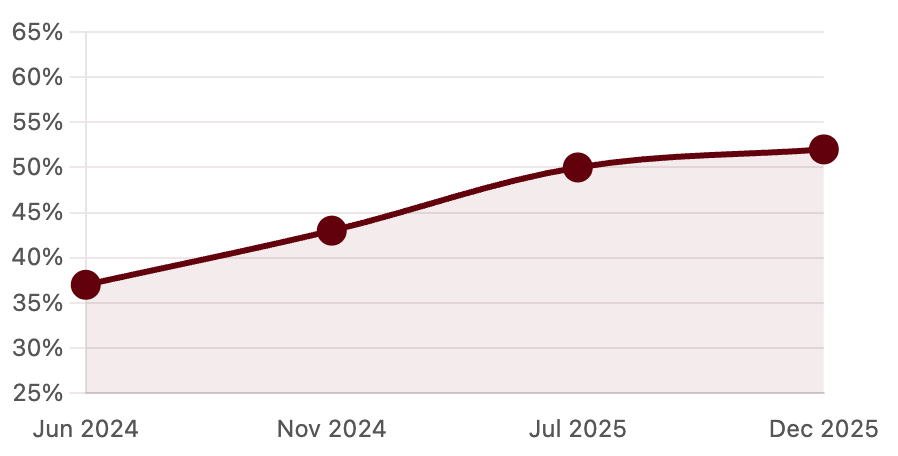
52%
ADULTS USING AI (WAVE 4)
4 waves
BIANNUAL, SINCE 2024
1,051
RESPONDENTS PER WAVE
4 countries
GLOBAL (UNESCO) REACH
Relevant signals – Wave 4
What the data reveals about AI in America
Key findings from the Winter 2025–2026 survey.
Each signal represents a measurable shift in how Americans relate to artificial intelligence.
1
From experimentation to infrastructure
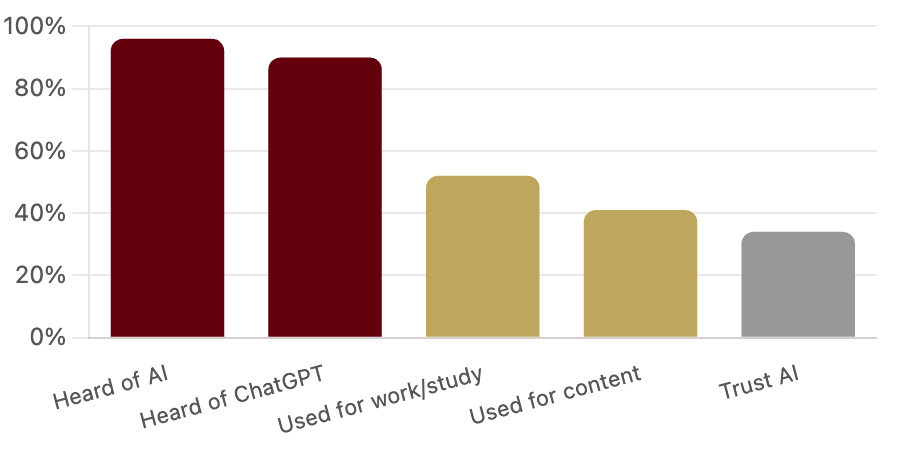
AI is no longer an experiment – it’s a default layer of interaction. 96% have heard of AI, 90% know tools like ChatGPT, but trust lags far behind.
52%
now use AI for work or study
2
AI as a gateway to news & information
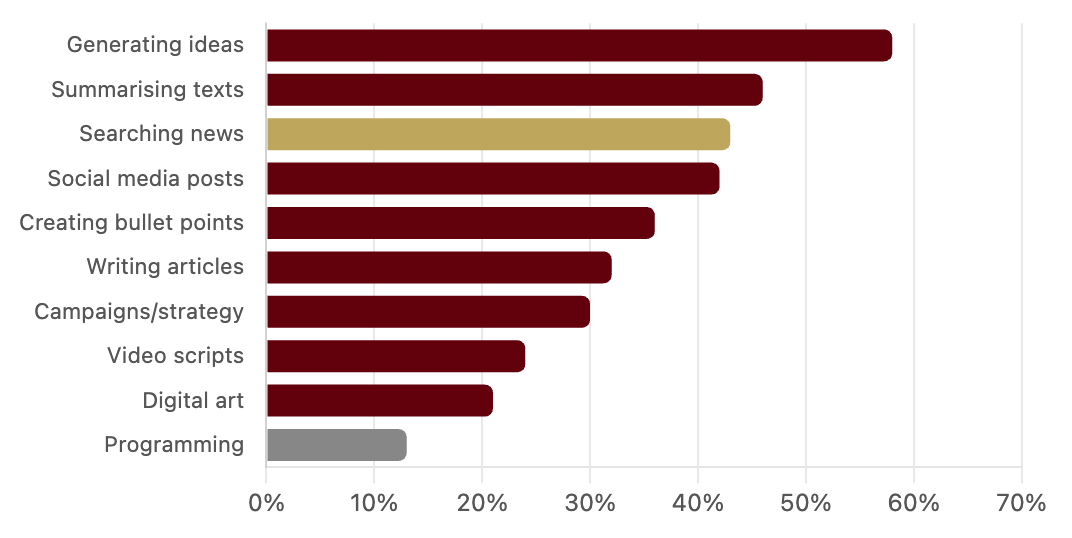
43% of AI users now search for news via AI assistants. AI is positioning itself alongside – or replacing – search engines as the first contact with the information ecosystem.
58%
use AI to generate ideas
3
Gemini reshapes the AI brand landscape
ChatGPT still leads at 82%, but Google Gemini jumped to 60% by Dec 2025. The era of ChatGPT’s near-monopoly is ending as alternative AI tools gain ground.
60%
now use Google Gemini
4
Productivity gains are no longer hypothetical
80% of AI users report improved productivity at work or study – up from 63% in June 2024. Negative effects have fallen to marginal levels (2%).
80%
say AI improves productivity
5
Trust in AI rivals trust in legacy institutions
AI tools now attract 34% confidence — comparable to news websites and the press. Universities and YouTube still lead, but AI has entered the trust ecosystem.
34%
trust AI tools – same as the press
6
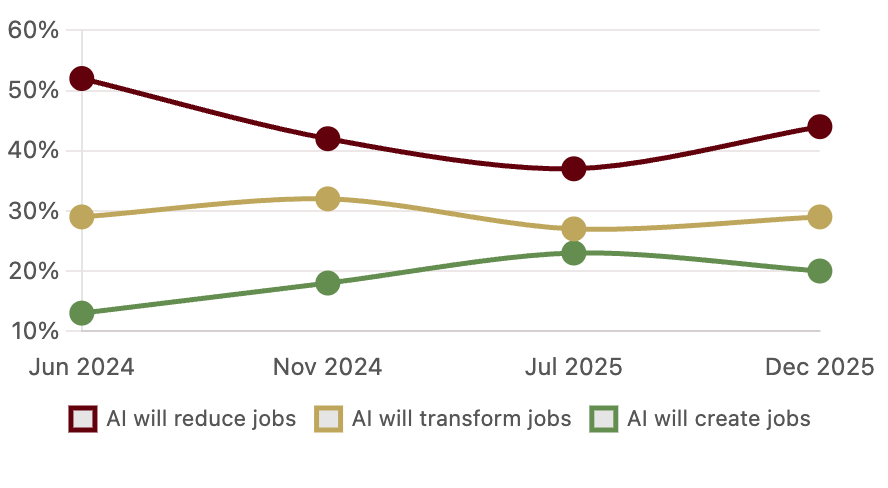
Fear of job loss dominates public anxiety
44% believe AI will eliminate jobs in their field. Workers in knowledge-intensive occupations are most likely to perceive AI as a threat — a key finding of regression analysis.
44%
fear AI will eliminate their job
Interactive Data – Wave 1 to Wave 4
Four waves of longitudinal data
Tracking the evolution of AI adoption, trust, and perception across all four survey waves
(June 2024 – December 2025).
AI adoption accelerating – and still climbing
% U.S. adults using AI for work, study or both
Awareness is high – trust lags far behind
Wave 4 snapshot: awareness, usage, and trust (% Yes)
How Americans use AI for communication tasks
% of AI users, by task type (Wave 4)
Views on AI and job impact – shifting over time
% believing AI will reduce the number of jobs
Original research
The AI Exposure Index
An original composite index measuring the public’s relationship with AI across four theoretically grounded dimensions –
from normative acceptance to risk minimization.
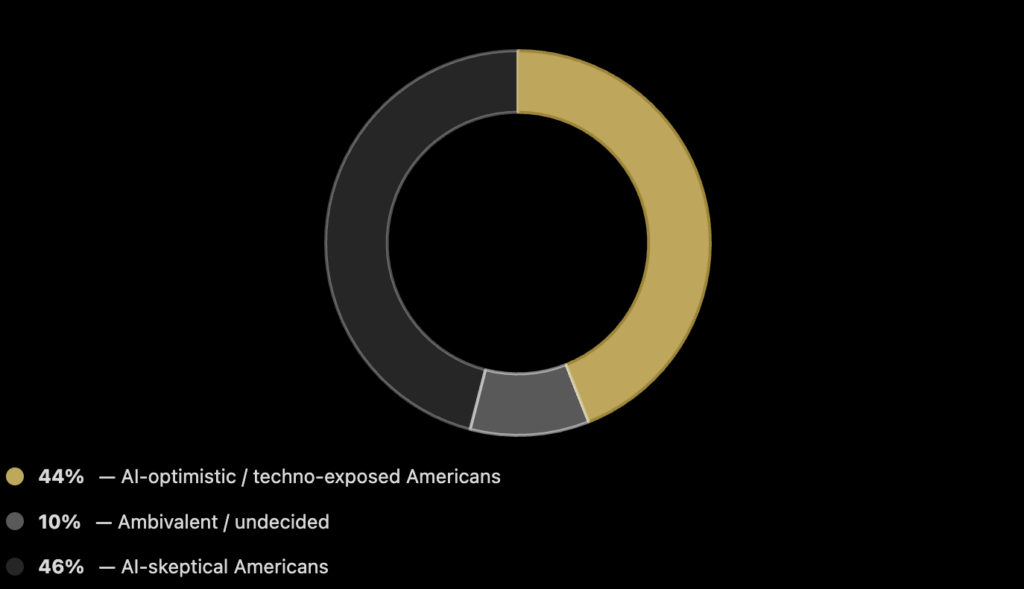
The U.S. public is roughly split between two orientations: AI-optimists (younger, educated, active users who see AI as productive) and AI-skeptics (older, lower usage, concerned about democracy and journalism quality). Most Americans fall somewhere between these poles.
Normative acceptance
Is professional AI use seen as acceptable across communication tasks?
Societal & journalistic benefits
Does AI improve society, democracy, and journalism quality?
Trust & confidence
Do users trust AI-generated content and their ability to detect it?
Risk minimization
Do users downplay risks like misinfo, polarization, and job displacement?

Why this research matters for journalism,
PR & communications
As AI reshapes how news is produced, verified, and consumed, communication professionals face new pressures: readers expect transparency, disinformation fears are rising, and AI is becoming a primary gateway to information.
The AI Public Opinion Tracker provides the empirical foundation to navigate this transition – grounded in nationally representative data, updated every six months.
- 43% of AI users now search for news via AI tools
- 72% demand mandatory disclosure of AI-generated content
- 58% need new skills to stay competitive — an opportunity for educators
- Trust in AI now rivals trust in mainstream news outlets
Research Reports
All four waves – free download
Each report is a comprehensive analysis with full methodology, cross-tabulations
and findings across demographics, professions, and geographies.
Wave 1
Summer 2024
June 2024 · 1,061 respondents
AI is no longer an experiment – it’s a default layer of interaction. 96% have heard of AI, 90% know tools like ChatGPT, but trust lags far behind.
- Inaugural measurement
- 37% AI adoption baseline
- 31% lack AI awareness
- Generational divide in AI knowledge
Wave 2
Summer 2024
June 2024 · 1,061 respondents
AI is no longer an experiment – it’s a default layer of interaction. 96% have heard of AI, 90% know tools like ChatGPT, but trust lags far behind.
- Inaugural measurement
- 37% AI adoption baseline
- 31% lack AI awareness
- Generational divide in AI knowledge
Wave 3
Summer 2024
June 2024 · 1,061 respondents
AI is no longer an experiment – it’s a default layer of interaction. 96% have heard of AI, 90% know tools like ChatGPT, but trust lags far behind.
- Inaugural measurement
- 37% AI adoption baseline
- 31% lack AI awareness
- Generational divide in AI knowledge
Wave 5 – LATEST
Summer 2024
June 2024 · 1,061 respondents
AI is no longer an experiment – it’s a default layer of interaction. 96% have heard of AI, 90% know tools like ChatGPT, but trust lags far behind.
- Inaugural measurement
- 37% AI adoption baseline
- 31% lack AI awareness
- Generational divide in AI knowledge
Supernoise
Stay ahead of the AI conversation
Subscribe to SuperNoise – our biannual newsletter delivering the freshest data, key findings, and expert interpretation from the AI Public Opinion Tracker, straight to your inbox.
[newsletter form]
Twice a year. No spam. Unsubscribe anytime.
Research Team
The people behind the data
An international collaboration between
the University of South Carolina’s College of Information and Communications
and the Social Monitor research team in Romania.

Dan Sultănescu, Ph. D.
Coordinator. SNSPA Bucharest & Social Monitor SRL, Romania
Principal Investigator
Linwan Wu, Ph.D.
Associate Dean for Research, College of Information & Communications, USC
Principal Investigator
Randy Covington
Professor, College of Information & Communications, University of South Carolina
Contributor
Andreea Stancea, Ph.D.
Statistics & Communication Specialist, Social Monitor SRL, Romania
Research Specialist
Dana Sultănescu
Research Specialist, Social Monitor SRL, Romania
Data Team
Emil Pîslaru
Data Analyst, Social Monitor SRL, Romania
Data Team

What makes this research distinctive is the rigor of its longitudinal design: the same methodology applied consistently across all four waves, with post-stratification weighting aligned to U.S. Census benchmarks — enabling valid trend analysis over time.
In 2025, the project expanded globally in partnership with UNESCO, collecting data across Mexico, Romania, South Africa, and the United States for the World Trends in Freedom of Expression and Media Development report.
Partners
University of South Carolina — CIC
UNESCO
Social Monitor SRL
IBM
Chernoff Newman