
Executive Summary
The University of South Carolina AI Index 2024, conducted by the College of Information and Communications provides a new perspective and new
analysis of the use and perception of artificial intelligence (AI) in
communication within the United States. The survey, which gathered
responses from 1061 U.S. residents, highlights insights into AI’s impact on
news consumption, social media engagement and professional
communication tasks.
Key Findings
1. Awareness and Perception of AI
Despite the increased media coverage, 31% of respondents have limited awareness of
AI, with 6% having no knowledge and 25% only a little. Conversely, only 36% report
significant familiarity with AI technologies.
There is a generational divide in AI awareness: younger individuals (18-24) are more
knowledgeable about AI tools like ChatGPT compared to older age groups.
2. AI in Professional and Academic Settings
38% of respondents have utilized AI tools for work or study, with higher usage reported
among younger individuals, those from the Western U.S., and those with medium to
high income levels. The primary barriers to AI adoption include a lack of trust (46%) and
skills (24%), overshadowing financial concerns. Among the predictors, social media
engagement shows a strong positive association with AI assistant usage. Individuals
who are more engaged on social media are significantly more likely to use AI assistants.
Age has a notable negative effect on the likelihood of using AI assistants: older people
are less likely to use AI assistants than younger people. Education level is positively
correlated with usage: higher education levels increase the probability of using AI
assistants. Income similarly shows a positive and significant correlation. Political
engagement, irrespective of the specific orientation, is associated with increased AI
assistant usage. Trust in universities also has a positive impact on the likelihood of
using AI assistants.
3. Impact on Productivity and Challenges
The survey reveals that ChatGPT is by far the most well-known and widely used AI tool.
Its usage is double that of Google Gemini and nearly triple that of Microsoft Copilot.
AI tools are perceived to enhance productivity, with Microsoft Copilot users reporting
the highest improvement rates (76%), followed by Google Gemini users (75%), and
ChatGPT users (68%).
Source: page-005.txt
The University of South Carolina AI Index / JULY 2024
 4
Key challenges in using AI include handling complex requests and ensuring accuracy,
with 13% of users noting frequent corrections needed.
4. AI in Content Creation
71% of professionals in Communication and Media use AI for content creation. Daily
usage is high among these professionals. AI tools are also widely used in Science and
Engineering (47%), Services (50%), and Finance (36%).
5. Ethical and Privacy Concerns
Only 27% of respondents are aware of ethical guidelines for AI use in their field. Ethical
concerns are more prevalent among women and those with higher education levels.
Privacy issues have been encountered by 12% of users, highlighting the need for robust
ethical frameworks and user education.
6. The influence over Journalism
Public opinion on AI's role in journalism is divided: 46% see a positive influence, 36%
see a negative impact. 46% fear AI increases misinformation, though 33% believe AI
could help reduce it. Higher trust in the press and universities is associated with a more
positive perception of AI's impact on journalism.
Belief that AI influences political views correlates with a more negative perception of its
impact on journalism.
The perception that AI increases the spread of misinformation has a strongly negative
correlation, suggesting that concerns about misinformation are associated with a more
negative view of AI's impact on journalism.
7. Future of Jobs in Communication
52% fear job reductions due to automation, while 29% expect job transformation
requiring new skills. Older respondents are more skeptical about AI's impact on job
markets compared to younger individuals. Higher trust in science, government, and
universities corresponds to a lower likelihood of believing AI will reduce jobs. Social
media engagement correlates with fewer concerns about job reductions. There are
gender differences. Males are less likely than women to believe that AI will reduce jobs.
Higher income individuals are slightly less likely to believe that AI will lead to job
reductions.
Implications
Our findings underscore the need for increased AI literacy and trust-building measures.
The survey highlights the necessity for ethical standards and regulatory frameworks to
manage the integration of AI into communication. Understanding public perceptions
can guide policymakers and developers in creating balanced, inclusive AI strategies
that address societal concerns while maximizing technological benefits. The findings
from this survey can inform future developments in AI technology and its application in
the communication industry. In summary, this survey offers a comprehensive analysis
of AI's role in communication within the United States, providing critical insights that
can guide future advancements in this rapidly evolving field.
About this initiative
Source: page-006.txt
The University of South Carolina AI Index / JULY 2024
 5

ABOUT THIS INITIATIVE

This research initiative is aimed at understanding the utilization and impact of some
specific form of AI - large language models (LLMs), such as OpenAI's ChatGPT, Google's
Gemini (former Bard), and other AI specialized in generative AI for communication, on
content creation and communication practices in the United States. Through a
biannual national survey, supplemented by social media listening in a later phase, this
project examines the ways in which individuals and organizations leverage AI
technologies for various communication purposes.


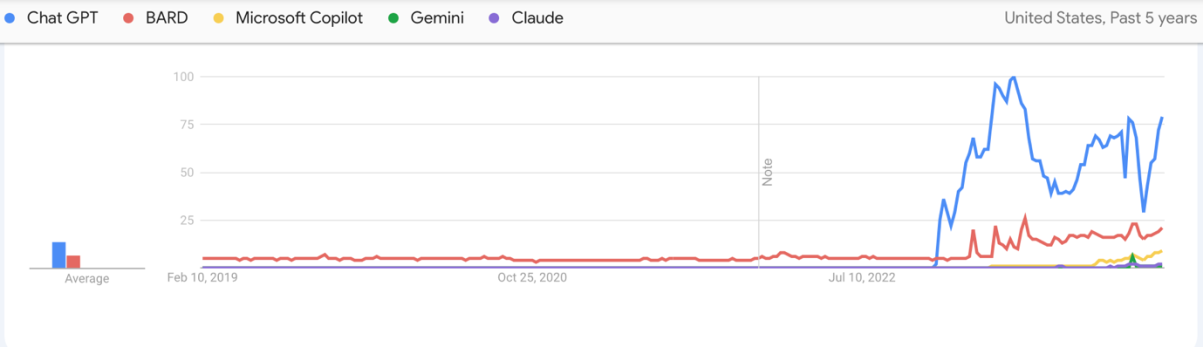
Figure 1 Interest in different forms of Generative AI in the US, in the last years. Google Trends data

The College of Information and Communications at the University of South Carolina
intends to repeat this survey periodically to monitor the evolution of AI perceptions and
usage patterns over time. Future research will focus on tracking changes in public
sentiment, identifying emerging trends in AI adoption across different sectors, and
examining the long-term impacts of AI on communication practices. By continuously
gathering data, the college aims to provide valuable insights that can inform policy
decisions and technological advancements, ensuring that AI developments align with
societal needs and ethical considerations.
How We Did This
Source: page-007.txt
The University of South Carolina AI Index / JULY 2024
 6
HOW WE DID THIS

The AI Index explores various aspects of AI, including its impact on news consumption, social media
engagement, and professional tasks related to communication. It aims to gather data on the frequency of
AI tool usage, the types of tasks AI assists with, and the overall sentiment towards AI's role in
communication.
Survey Design and Coordination
This survey was designed by a team of experts led by Dr. Dan Sultanescu and Dr. Linwan Wu, from the
College of Information and Communications, University of South Carolina. The primary objective was to
measure the use and perception of artificial intelligence (AI) in communication within the United States.
We appreciate the support of Prof. Randy Covington and the expertise of the statistics and
communication specialists from the Social Monitor team in Romania, Dr. Dana Sultanescu and Dr.
Andreea Stancea, for their contributions. Additionally, we are grateful for the support and
encouragement from Dean Tom Reichert, whose assistance was instrumental in moving this project
forward and keeping us on track.
Methodology
The survey was conducted in the last week of June, 2024 using the Computer-Assisted Web Interviewing
(CAWI) method via the Qualtrics platform. A total of 1,061 complete responses were collected. It is
important to note that online samples tend to under-represent the opinions and behaviors of people who
are not online (typically those who are older, less affluent, and have limited formal education). Moreover,
because people usually opt in to online survey panels, they tend to over-represent people who are well
educated and socially and politically active.
Sampling and Data Collection
The survey sampled respondents across different age groups, genders, and regions in the United States.
It included individuals from various educational backgrounds and professional fields, ensuring a
comprehensive overview of AI usage and perceptions.
Weighting and Representativeness
The database was weighted to be representative of the U.S. voting population based on the most recent
U.S. Census data. Adjustments were made for age, gender, education, ethnicity/race, location, income,
and occupation type. These adjustments were relatively small, ensuring that the results accurately
reflect the population.
Data Analysis
For our data analysis, we started by weighting the database for representativeness. We then generated
descriptive statistics for all variables to understand the dataset better. Using crosstabulation, we
examined relationships between variables and identified significant patterns. We conducted exploratory
factor analysis to uncover underlying structures and tested these connections with correlation analyses.

We also built logistic regression models to identify significant influences on the use of AI tools,
perceptions of AI's impact on journalism, and concerns about AI's influence on journalism. This
approach allowed us to derive valuable insights into the factors shaping these opinions.